

Funkentelechy in Art Rehab
- by Miranda Gavin
- in Arteles artist residency collaboration concepts Creative Finland mixed media photography visual art
- posted May 21, 2019
The week is intimately textured and the schedule is varied but from Monday-Friday it always commences with a morning ritual which challenges my usual waking-up routine. This is probably a good thing. Starting the day with two cups of tea, rather than coffee, marks me as ‘typically English’ and even though I try to shake it off, the stereotype persists as it is based on some truth. The kitchen is the hub, a space in which we meet, eat, chat and cook. I already know who in The Yellow House prefers to wake up to a cup of coffee, who likes tea, and who hasn’t been sleeping very well. Sharing a bathroom and kitchen with five other women also gives a sense of our different morning paces although getting to the loo and the shower requires negotiation and flexibility as does preparing and cooking meals. If six people take 10 minutes to shower that’s sixty minutes prep time. So far, we seem to be managing.

I have taken to using the term Art Rehab to describe the creative process of New Course and I use it in a playful way. It is both a nod to the concept of rehabilitation and the breaking of habits as well as a cheeky spin on the development of rituals of practice in the context of art and creativity. In the blurb for the course, it says that it takes 21 days to form new habits and re-condition daily routines. For me, it is also about regaining confidence in relation to putting my work ‘out there’ for public consumption (a form of letting go) and releasing my creative potential. For too long I have kept work under my bed, literally and metaphorically, and have been a Reluctant Art Exhibitionist. Now I am intent on removing the reluctant especially as I am older now, less self conscious and, increasingly, I feel that the F**k-it approach to disseminating work is the best way forward. If you don’t put it out there, who will? And what’s the worst that can happen?

Twice a week we have group activities that engage a spirit of collaboration and experimentation that appears to be at the heart of the programme. We are encouraged to push beyond comfort zones, to see obstacles as opportunities, and failure as simply a part of life and the creative process. To quote playwright Samuel Beckett:
Ever tried. Ever failed. No matter. Try Again. Fail again. Fail better.

I have always liked Beckett’s quote and have recited it to groups of photographers who I work with in the UK when I am facilitating Tri-Pod workshops. You can’t learn a language without making mistakes and getting it wrong; you can’t learn to do anything without some aspect of failure becoming part of the process. Yet, it is challenging to be seen to ‘fail’ in front of others and my comfort zone is being stretched when it comes to the more performance-based parts of the course. I am OK reading out to groups and giving talks but when it comes to moving and improvising in space, the three-dimensional me sometimes forgets that it is housed in a physical container with an outline and end points. A lot of my life has been spent existing outside this shell and it takes me time to regroup on a cellular level in this dimension.

Only once have I experienced what I later came to feel was a form of astral projection and it was not drug-related,. It took place in Cairo in the late 1980s when I was travelling down The Nile with a friend, having just spent three months studying photography with her at Bezalel Academy of Art and Design in Jerusalem. I floated above our beds in the room and recall that it was vivid, disembodied, and slightly scary. It’s an experience that I’ve never forgotten.

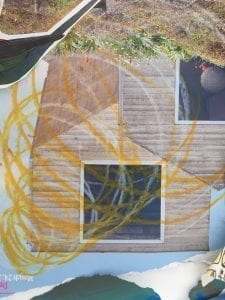
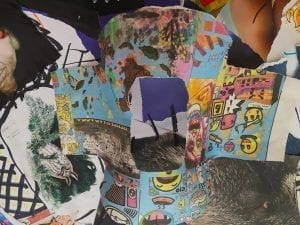
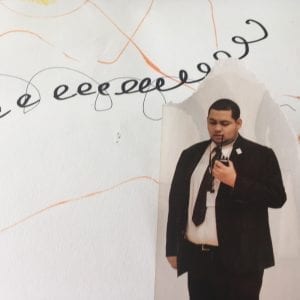
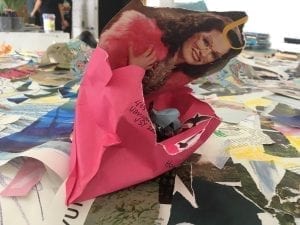
Fortunately during the first week, when we are getting to know each other, we play with coloured pens, glue sticks and magazines to make collaborative and individual works, details of which I photographed—this has the effect of flattening and sectioning the group collage. My photographs here of our work and some of my contributions to the group collage also reveal associations and intersections that I am still contemplating.
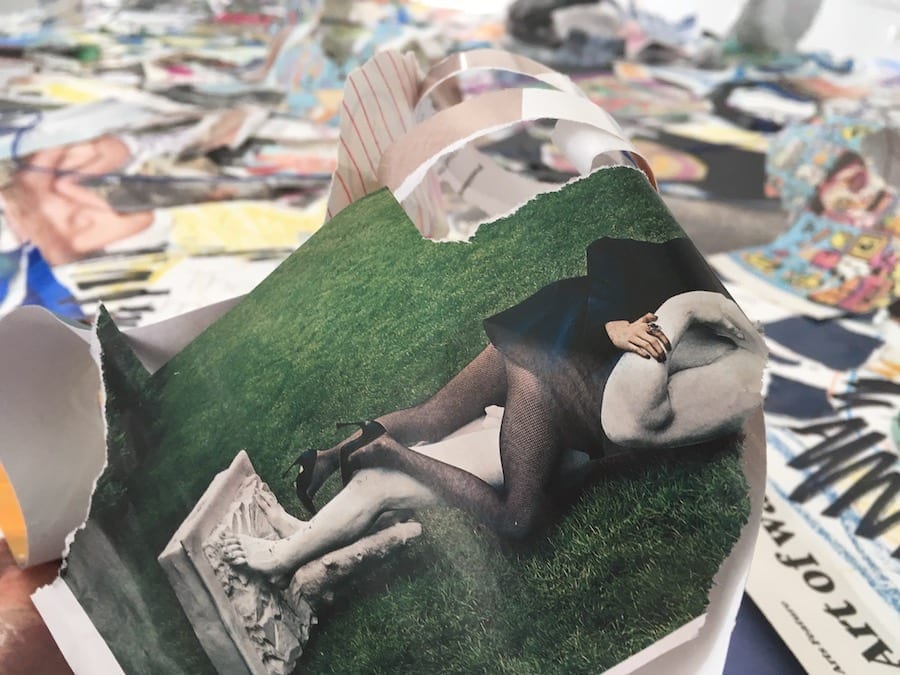
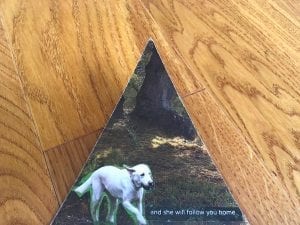
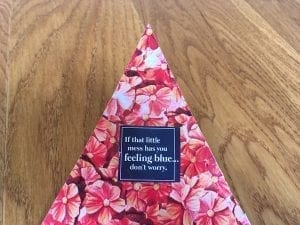
In a later workshop Margi takes us on a journey related to the concept of entelechy, which we manifest as a physical object. Entelechy is derived from the Greek, entelecheia, and has a few meanings including “in philosophy, that which realizes or makes actual what is otherwise merely potential”. I love tracking the origin of words and then interlacing the different meanings to reach an understanding that makes sense to me.
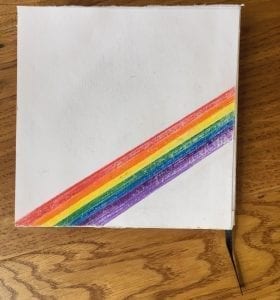
My Prism Pyramid
I also learn that it was used by Aristotle from Greek entelekheia and can be broken down into its components: en- ‘within’ + telos ‘end, perfection’ + ekhein ‘be in a certain state’.
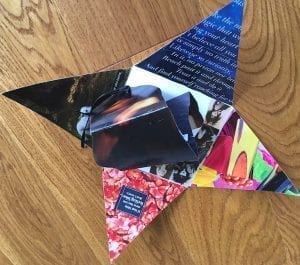
The word entelechy has other nuances, namely:
- The supposed vital principle that guides the development and functioning of an organism or other system or organization—‘such self-organization required a special biological force—entelechy’.
- An entelechy ‘generating a work of art from within’
- The soul
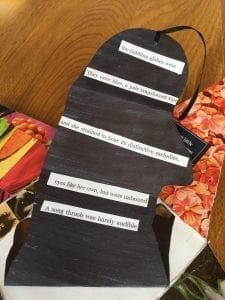
It has to be said, everything is starting to seem significant and the correlations and resurgence of ideas and references is vital. The more receptive I am, the more these associations coalesce. This is facilitated by Margi with the help of the residency assistant, Carrie, and residency coordinator, Ida, (generous-spirited women who deal with our needs patiently and with grace); the environment (Arteles, nature and Finland) and The Group (an eclectic and diverse mix of characters, all of whom appear to be open to learning and sharing). While I am musing on all of this, a song by the band Parliament, headed up by the fab George Clinton, keeps seeping into my mind and I am singing it to myself while I make my paper sculpture. If you haven’t heard it, here’s a link to a video and some lines from the song.
Name that feeling, baby
This is Mood De-control
Program, reprogram and deprogram
Funk-entelechy (how’s your Funk-en-te-lechy?)