


Part Six: The Camino Under Covid-19: the different ways
- by Miranda Gavin
- in camino Camino de Santiago Camino del Norte concepts Coronavirus cosmos Covid-19 Creative global pandemic Miranda Gavin movement nature photography The Way of Saint James travel walking writing
- posted August 31, 2020
It can be confusing when people say that they are ‘doing the Camino’ as there are a number of different routes. In fact a well-known Camino saying is that there are as many Caminos as there are pilgrims. The Camino de Santiago is known in English as the Way of Saint James (Santiago translates as Saint James) and ultimately reaches its destination, whichever route one takes, at the tomb of James the Apostle. A useful way of envisaging the network of pilgrim routes is to imagine it as a river system in which brooks flow into rivers, the majority of which feed into one of the main routes, the Camino Francés.


This is the most popular route and is the one that meanders 780 kms from St Jean-Pied-du-Port in south-west France to Santiago in the region of Galicia north-west Spain. Before its start near Biarritz the path is fed by three main French routes: the Voie de Tours, the Voie de Vezelay, and the Voie du Puy.


Each route has its own personality and each traverses different terrain with varying degrees of difficulty, most of which require physical and mental stamina. Some of the Camino Frances crosses the Pyrenees, while others such as the Camino del Norte follows the peninsular coast from east to west, starting in Irun on the French border. The latter, also known as the Camino de la Costa, is demanding as it involves walking stages of between 20-35 kms, often hiking up and down steep coastal paths or stone stairs. However, its toughness is offset by its beauty. At 825kms, it crosses four provinces and, in so doing, highlights geographical and cultural differences as it cuts through the Basque Country, Cantabria, Asturias and Galicia.
The shortest route at 118 kms starts at A Coruña or Ferrol and is known as the El Camino Inglés, The English Way, or the Camino de Los Ingleses. This route was used as the main route for pilgrims travelling from England, Scotland, Ireland and other Nordic countries. The oldest route is the 355km Camino Primitivo, the Primitive Way, which splits off from the Camino del Norte near Villaviciosa and passes through Oviedo and Lugo en route to Compostela. The network has expanded and newer routes such as the Camino Portugues have been added. The reasons for this are manifold, yet one suggestion that makes sense is that Camino tourism brings in a much-needed income for many of the locals and businesses located along the way.

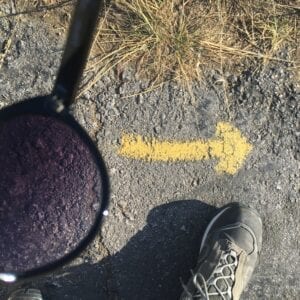
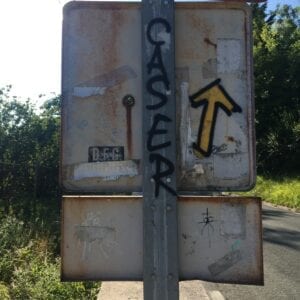
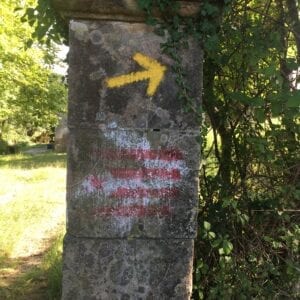
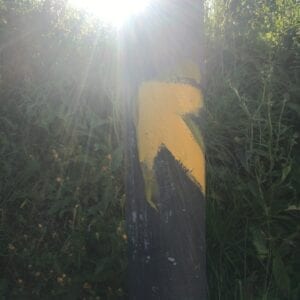
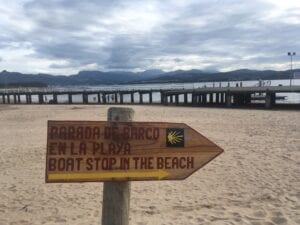
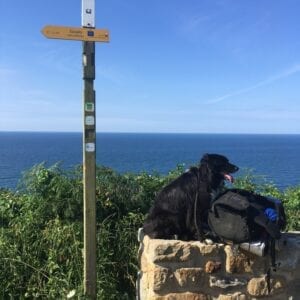
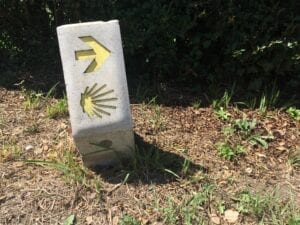
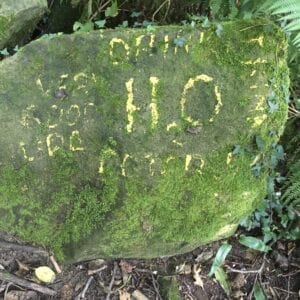
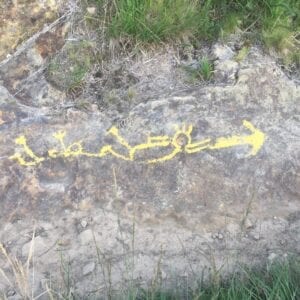
The yellow arrows are way-finding signs that can be found painted on roads, stones, walls and trees. In fact, anywhere and everywhere, and it can become extremely confusing finding the correct path to follow, which means that getting lost is as much about being ‘on the way’ as actually being on The Way itself. This is another metaphor for life, especially in our current times. In 2014, I attempted to walk, on my own, from Compostela de Santiago to Finisterre, a distance of 87 kms (54 miles). However, it was a disaster, not least because I followed the route printed on a napkin. That’s a story for a later post, but what is important is that six years later, I’m back on the Camino.
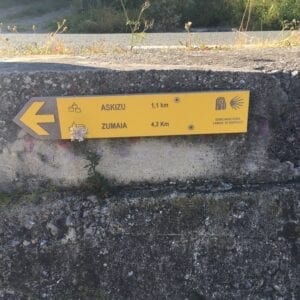

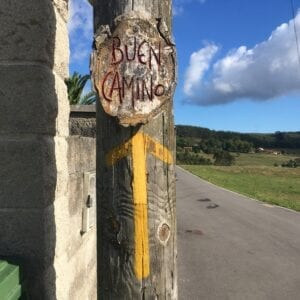
If you’ve seen the 2011 film, The Way, starring Martin Sheen and directed by his son Emilio Estevez then you will be familiar with the Camino Francés as the film follows Sheen retracing his late son’s footsteps on this path. I’ve yet to encounter anyone remotely resembling Sheen, although in Getaria, a small town in Pais Vasco, we spotted an Iggy Pop-lookalike strolling through a cobbled street. As with the film, Eat, Pray, Love, these Hollywood overland adventures to find oneself and discover what is important in life edit out all the non-essential plot devices, particularly the mundane and slow, in favour of exciting encounters that move the narrative along more swiftly. Unlike life. But if you’re a fan of the lingering gaze of the extraordinary Russian filmmaker Andrei Tarkovsky, or appreciate the static nature of Derek Jarman’s art film, Blue, (1992), you’d be fine with the Camino Real Time.

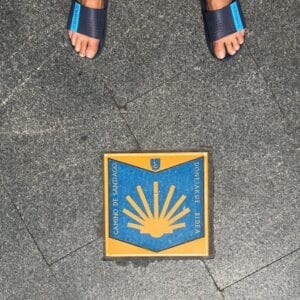
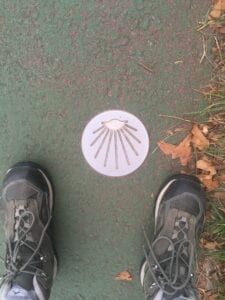
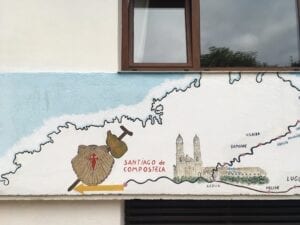
But what of the shell, the ubiquitous emblem guiding pilgrims in the direction of Santiago? Many contemporary pilgrims, like their medieval counterparts, can be seen with scallop shells attached to their rucksacks although they can break easily as they are both delicate and brittle. For this reason, I don’t carry one. I’m far too accident prone. The only time I’ve used one was as a soap dish which, though decorative, was extremely impractical and is not recommended for a pilgrimage. Where language is concerned it is also interesting to discover that in both French and German the scallop shell is named after Saint Jacques, or Saint James. The French use the term Coquille Saint Jacques, while in German scallops are referred to as Jakobsmuscheln, or James’ mussel.
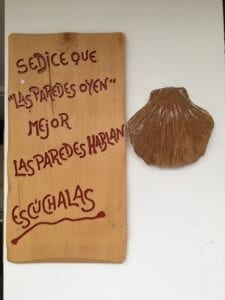
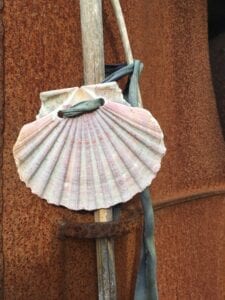
The shell is also a tool: it is believed that it was not only used as a bowl from which to drink water, but each scoop also measured the amount of food donated at churches and other places. Next time you’re in a church you may notice that the baptism font is shaped like a scallop. In Pre-Christian times, the scallop shell could also have symbolized the setting sun, which makes sense as the Way of Saint James heads west towards the setting sun on the Galician coast in Finisterre, translated as the End of the Earth, echoing the English place name, Land’s End in Cornwall.

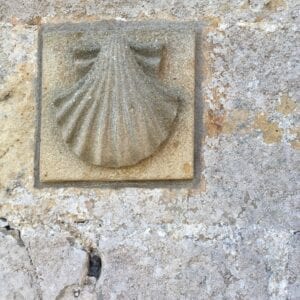
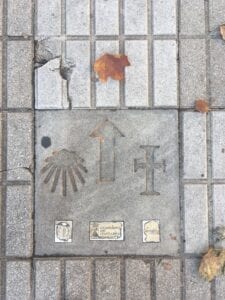
As with all symbols, interpretation lies in the feet of the beholder. Medieval Christians collected the shell at Compostela to prove that they had made the pilgrimage while the ray-like lines of the painted shell symbol are seen to represent the various walking trails pilgrims follow, eventually converging at St James’ tomb. In some guides, in print and online, a scale of shells indicates the level of difficulty of different stages of the various Caminos.
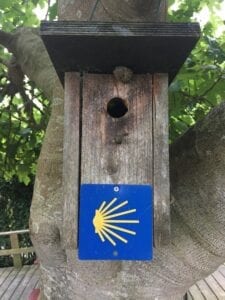


One legend I find particularly appealing recounts how the ship carrying Saint James’ remains passed a seashore wedding taking place on the Galician coast. The bride was on horseback and when the horse became frightened by the ship it dived below the sea with the bride still strapped to the saddle. Both emerged scallop-shell encrusted.

The other shell image is familiar from Botticelli’s painting, The Birth of Venus, (1484-14860), in which the goddess representing love rises from the sea, naked and fully grown, standing modestly on her scalloped chariot.
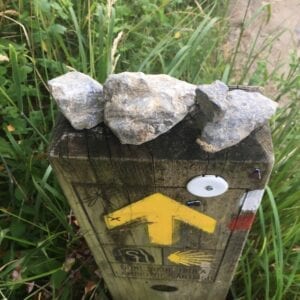
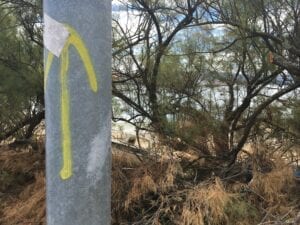
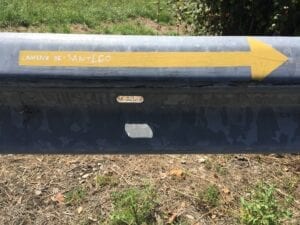
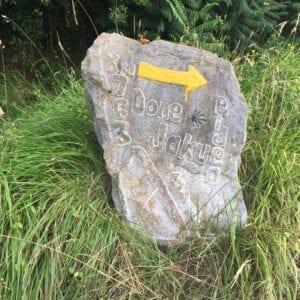
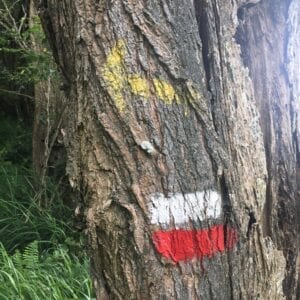
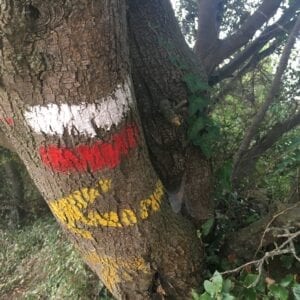
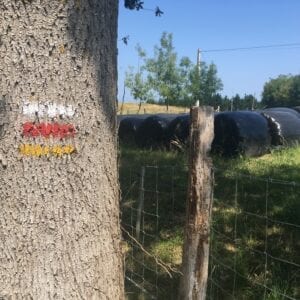
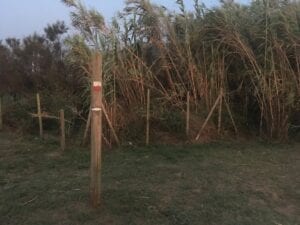
The use of yellow can be interpreted in many ways when, in fact, it is a colour that was used by chance. In the 1980s, Father Elias Valiña, a parish priest from the Galician village of O Cebreiro, influenced what we now experience as the Camino when he set out to mark the ancient route with yellow arrows so that pilgrims, or peregrinos, could more easily find their way. Valiña was assisted in his mission when a road maintenance company working on a signage project gave him its surplus of yellow paint making it a pragmatic, rather than a symbolic choice. Further guiding signs are the horizontal red and white lines indicating the Grande Randonnée network, or GR, the French name for the Chemin de Saint Jacques.


With Covid-19 permeating every aspect of our lives, I even found yellow arrows taped to the floor leading not to the Saint James’ tomb, but to a different spirit all together–the bar in a restaurant. Unlike Valiña’s arrows, these 2020 counterparts signaled the flow of human traffic entering and leaving the restaurant.

Another tool which many pilgrims use are walking sticks or poles. These not only help with stability, especially on a descent, but also doubled up as weapons in medieval times. With a pointed metal stabbing instrument at one end, the stick could be used to both attack and protect.

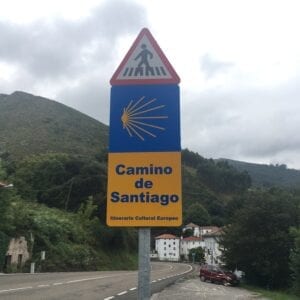
The 12th and 13th century are considered to be the heyday of the Camino de Santiago, although there are earlier records showing that the first pilgrims were in the 10th century and many more in the 11th. Later, during the Renaissance and Reformation years the number of pilgrims declined and the popularity of the route has, at times, been adversely effected by wars, natural disasters and epidemics (it’s all starting to sound rather familiar). However, on 1 November 1884 after Pope Leon XIII declared that the relics preserved in Santiago de Compostela were authentic (Papal Bull Deus omnipotens) and those of Saint James, the pilgrimage experienced its modern revival.
Saint James is one of the 12 great apostles. “Nothing is known of St. James the Greater’s early life, though it has been established that he is the son of Zebedee and Salome and brother of John the disciple,” notes the website, Catholic Online. “The title ‘the Greater’ was added to St. James’ name to help distinguish him from the Apostle James “the Less,” who is believed to have been shorter than James “the Greater.” Saint James the Greater was one of Jesus’ first disciples. As he was not allowed to be buried following his martyrdom, his remains were taken to Compostela, Spain, by some of his followers, who buried him. In the ninth century his remains were discovered and moved to a tomb in Santiago de Compostela. Today, his remains can still be found in the Cathedral of Santiago. Because Santiago de Compostela is the most frequently visited place pilgrims migrate to following Rome and Jerusalem, Pope Leo declared it a shrine.”
Although we were on the Camino in Zarautz on the 25 July which is his feast day, there were no fiestas or celebrations because of Covid-19–just lots of locals drinking and eating in bars with their masks hanging like hammocks under their chins. In Spain, mask wearing is taken extremely seriously. It’s obligatory to wear a mask outside in the street as well as on public transport and in public places. If you don’t the Guardia Civil will stop you: one policeman wound down the window of his car, calling out to me, “Mascarilla ‘Mascarilla!”At first, I thought it had something to do with my mascara, which didn’t make sense as these days I am (mostly) non-make-up wearing. This is another Camino must, no extra baggage, and that means hair and beauty products whittled down to the minimum.
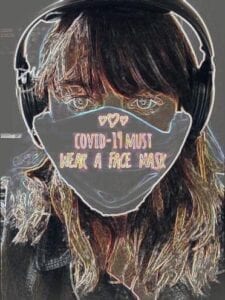
So far Spanish cities have tended to be stricter than villages and some concerned citizens have gestured and shouted at me when they walked past to “put my mask on” (visualize the accompanying hand gesture moving up and down in front of the bottom part of their face). This has even occurred on empty coastal footpaths where there has been far more than two metres distance. Once when I was crossing a bridge in Santona, Pais Vasco, a terse, tight-faced woman told me off while I was in the middle of eating half a lemon (an attempt to boost my immune system and keep my Vitamin C levels up). When I turned back to stare at her, lemon held high, she softened. But that’s human nature for you, some people like to enforce the rules and CV-19 is the perfect excuse for this kind of citizen policing.


The Camino de Santiago means different things to different people: there are those who take to the road for holy, or spiritual, reasons; others who enjoy the physical and sporting aspect, others set out to meet fellow pilgrims and learn about other cultures while some, myself included, view it as a personal endeavour. One short documentary that may be of interest is Footprints: The Path of your Life (2016) which follows a Spanish Catholic priest and nine men from different backgrounds who walked 500 miles in 40 days. Suffice to say, I’m not doing the hardcore, extreme sport version. Knowing me, if I did, I’d probably lose myself.

As I walk, I discover that my reasons for doing the Camino echo the pilgrimage network itself–they are dynamic, rooted in history and personal mythology and, like the weather in these regions, subject to hourly variations. What doesn’t change is that this adventure is allowing me the time and space to reflect on life while doing something physical and elemental, al fresco, with everything that I need on my back. Call it my Snail Trail.

FOR THOSE WHO WALK THERE IS ALWAYS A SUNRISING
WALKING IS GOING THROUGH THE NIGHT IN HOPE
AND DISCOVERING EVERY DAY THE TRUTH OF UTOPIA
AND THE LIFE OF LOVE
(rough translation of the words above from the must-visit Albuergue de “La Cabaña del Abuelo Peuto” in Guemes)
All photographs copyright Miranda Gavin, 2020. Except images of Guido Reni’s painting of Saint James, Botticelli’s The Birth of Venus, and Kevin St Alder’s digital art version of My Masked Covid-19 selfie.
Comments
Inside Her Platypus
September 1, 2020 at 2:12 amAhhh. That was simply sublime.
It’s like listening to a romantic scholar, it makes you dreamy. ☆♡☆
Son of Zebadee?
….totem protector right there.